
What You Need to Know
- A Fractional CIO (vCIO) provides executive-level IT strategy on a fractional basis. In other words, you get C-suite guidance without hiring a full-time executive.
- vCIO services include IT roadmapping, budget planning, and cybersecurity oversight. They also cover vendor management and technology alignment.
- For businesses with 20 to 150+ employees, a vCIO fills the gap between basic IT support and real strategic leadership.
- A full-time CIO costs $200,000–$350,000 per year. vCIO services deliver comparable expertise at a fraction of that cost.
- The right vCIO partner does more than manage your technology. They also help you use it as a competitive advantage.
Your Business Is Growing. Your IT Strategy Probably Isn’t Keeping Up.
Most small and mid-sized businesses hit a wall. Day-to-day IT support stops being enough. The servers are running. The help desk is handling tickets. The antivirus is up to date. However, nobody is asking the harder questions. Is your technology supporting where you want to go in three years? Are you overspending on tools that don’t work together? If your systems go down on a Friday, what happens Monday?
These are not IT questions. They are business questions. For that reason, answering them requires someone in a strategic leadership role — not just a technician.
That is exactly the gap that virtual CIO services fill.
A vCIO brings executive-level technology leadership to businesses that need it. However, most organizations in the small and mid-sized market still go without one. It is one of the highest-value services available to growing businesses today.
This article explains what a virtual CIO does, when your business needs one, and what to look for in a provider.
What Does a Virtual CIO Actually Do?
A virtual CIO is a senior technology advisor. They work with your leadership team on a part-time or fractional basis. Their goal is to plan, manage, and optimize your IT environment at a strategic level.
The role is different from traditional IT support. Your managed IT provider handles daily operations — monitoring, help desk, and security patching. The vCIO, in contrast, operates one level above that. Their focus is on the bigger picture.
Core responsibilities of a vCIO include:
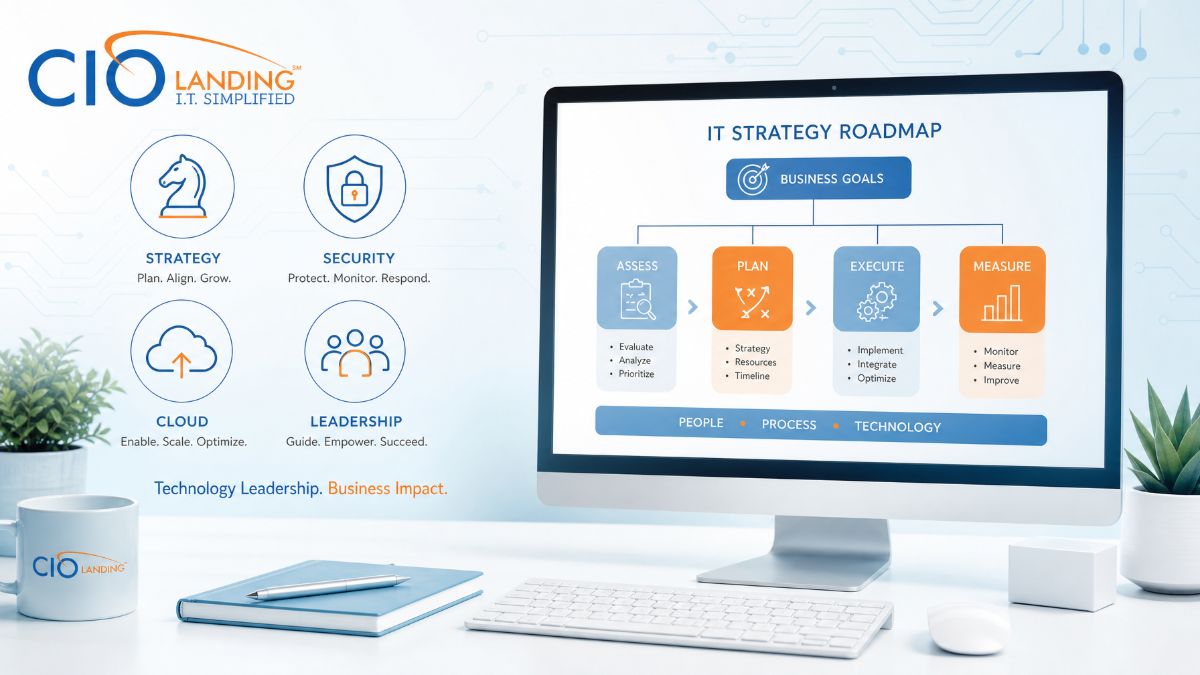
- IT roadmapping: Building a multi-year technology plan aligned with your goals. This also accounts for your budget and growth trajectory.
- Budget planning: Reviewing your current IT spend and identifying waste. As a result, you invest where it actually matters.
- Cybersecurity strategy: Assessing risk and establishing security frameworks. This is especially critical for businesses in regulated industries.
- Vendor management: Evaluating technology vendors and negotiating contracts. They also hold providers accountable for performance.
- Business continuity planning: Ensuring you have a real plan to recover from outages or data loss — not just a backup drive collecting dust.
- Technology alignment: Making sure every tool you invest in supports how your people work.
In addition, a strong vCIO serves as a translator between your technical team and your leadership. They explain technology decisions in plain business terms. As a result, your leadership team can make informed choices without needing a computer science degree.
Five Signs Your Business Needs a vCIO
You do not need to be at a crisis point. In fact, the businesses that get the most value from a vCIO are growing ones. Here are five clear signals to watch for.
1. Technology decisions are reactive, not planned.
If you buy new software only when something breaks, you are operating without a strategy. A vCIO, therefore, replaces reactive decisions with a proactive roadmap.
2. You have no idea if your IT budget is well spent.
Many businesses pay for tools they barely use. In addition, they often maintain redundant systems or overpay for contracts that were never renegotiated. A vCIO audits your spend and ties every dollar to an outcome.
3. Your IT team handles fires, not the future.
IT staff are excellent at keeping things running. However, keeping things running is not the same as planning for growth. If your team is stuck in reactive mode, a vCIO gives them the strategic direction they need.
4. Cybersecurity feels like a checkbox, not a program.
Installing antivirus software is not a cybersecurity strategy. As threats grow more sophisticated — especially in legal, financial, and manufacturing environments — you need someone actively managing risk. For this reason, a vCIO is especially valuable in regulated industries.
5. You cannot connect technology to your business goals.
This is the most telling sign. If your leadership team cannot explain how IT supports your objectives, you lack strategic IT leadership. A vCIO makes that connection explicit.
vCIO vs. In-House CIO: The Real Difference
Some businesses assume they need to hire a full-time CIO. For most businesses under 150 employees, however, that is not the right move — and not just because of cost.
A full-time CIO commands a base salary of $200,000–$350,000 per year. That figure does not include benefits, equity, or onboarding costs. For many organizations, therefore, that investment simply does not make sense at their current stage.
There is also a depth-of-experience consideration. A vCIO works with multiple clients across industries. As a result, they bring a breadth of perspective that a single in-house hire rarely has. They have seen what works — and what fails — across dozens of organizations at different stages of growth.
CIO Landing, for example, pairs vCIO services with hands-on technical support. So the strategy and the execution are always coordinated. Your vCIO is not working in isolation from your IT team — they are directing it.
For most businesses in the 20–150 employee range, a vCIO through a trusted MSP delivers more value than a full-time hire at the same investment level.
How vCIO Services Support Legal, Financial, and Manufacturing Businesses
The value of a vCIO shifts depending on your industry. Here is how it plays out across CIO Landing’s core markets.
Legal firms face growing requirements around data privacy, client confidentiality, and document security. In addition, many face compliance obligations tied to HIPAA and state bar data security rules. A vCIO builds an IT strategy that keeps the firm compliant. They also ensure attorneys and staff have the tools to work efficiently — from secure document management to reliable remote access.
Financial services firms deal with sensitive client data and strict audit requirements. In addition, regulators are increasing pressure around cybersecurity and business continuity. A vCIO helps financial firms build infrastructure that holds up under scrutiny. For example, they establish structured disaster recovery plans, documented security controls, and audit-ready systems.
Manufacturing companies are increasingly dependent on integrated technology — from ERP systems to connected shop floor equipment. However, many lack the IT leadership to manage that complexity. A vCIO helps manufacturers evaluate the right platforms and protect operational technology from cyber threats.
Above all, the through line across all three industries is the same. Technology decisions need a senior leader who understands both business context and the technical landscape. That is the role the vCIO fills.
What to Look for in a vCIO Partner
Not all vCIO services are the same. So, when evaluating providers, keep these criteria in mind.
Business fluency, not just technical knowledge. The best vCIOs understand how businesses operate. They ask about your revenue goals and your growth plans — not just your server specs.
Industry experience. A vCIO with experience in your sector understands your regulatory environment. In addition, they recognize your common technology pain points before you have to explain them.
Integration with your IT support team. If your vCIO is disconnected from your day-to-day IT, the strategy will be hard to execute. For this reason, look for a provider where the vCIO and the support team work together.
Regular, structured engagement. A vCIO who checks in once a quarter is not adding much value. Instead, look for someone who meets with your leadership team consistently and tracks progress against your IT roadmap.
Transparency and communication. Your vCIO should explain every recommendation in plain language. In other words, if they cannot tell you why a technology decision makes business sense without using jargon, they are not doing the job.
Ready to Think Strategically About Your Technology?
CIO Landing provides virtual CIO services for small and mid-sized businesses in the Chicago area. We also bring deep experience serving legal, financial, and manufacturing organizations.
Our vCIO team works alongside our managed IT and cybersecurity experts. As a result, you get strategy and execution in one place — not two separate conversations.
If your business is ready to stop reacting to IT problems and start using technology to drive growth, we would like to talk.
Schedule a Discovery Call to speak with a member of our team about what a vCIO engagement looks like for your organization.
Ready to Stop Worrying About IT?
Book a discovery call today.
Business leaders trust us to simplify their technology decisions. Find out how we can streamline yours in just 30 minutes.